

Slippery stairs are a serious safety hazard in both homes and businesses. Every year, accidental slips and falls on steps result in devastating injuries and even deaths — over 19,000 fatalities in the U.S. annually — and impose an economic burden exceeding $30 billion per year. More than 2 million people end up in emergency rooms each year due to slip-and-fall accidents. These sobering statistics underscore why it’s crucial to make stairways as safe and slip-resistant as possible.
When it comes to outdoor stair safety, homeowners have three primary options for non-slip treads: rubber mats for stairs, grit tape for stairs, and permanent non-slip treads. While each stair traction solution initially appears to offer benefits, their long-term performance, safety, reliability, and cost-effectiveness can vary. This comprehensive analysis examines all three anti-slip stair tread options to help you choose the best non-slip treads outdoor solution for protecting your family and property.
Non-slip treads are specialized safety products designed to increase traction on stairs and help prevent dangerous falls. The wrong choice in stair treads can create a false sense of security while still leaving you vulnerable to accidents.
The three main categories of non-slip treads outdoor solutions work through different mechanisms, and they differ in how well they maintain safety over time. Understanding these differences is crucial because a safety solution that degrades unnoticed can fail when you need it most.
Rubber mats for stairs are flexible products designed to lie on or adhere to individual outdoor steps. These non-slip stair mats feature textured surfaces with various traction patterns molded into rubber compounds. Companies like Global Industrial and American Floor Mats manufacture different types of rubber stair mats, though their outdoor performance limitations are well-documented.
Rubber mats can be attractive due to their moderate cost (often about $8–$25 per step) and cushioned feel underfoot. Installation is simple — many just lay in place or use adhesive backing.
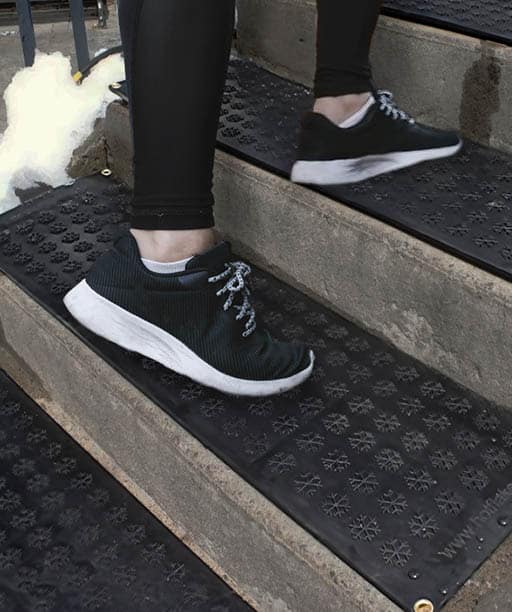
However, there’s an important caveat: long-term safety depends on the condition. Rubber is susceptible to UV exposure and temperature swings, which can lead to brittleness, cracking, or a loss of surface texture over time. Expansion and contraction can also stress adhesive bonds.
Winter conditions tend to reveal the biggest limitations. Ice formation can make rubber surfaces slick, and snow accumulation covers textured features, reducing traction. Because mats sit on top of the stair surface, they can trap moisture underneath, encouraging mold and algae growth that further reduces grip unless cleaned regularly. Loose or degrading mats may curl or shift, creating trip hazards.
While rubber mats are economical in the short term, typical outdoor lifespans in the range of ~18 months to 4 years lead to ongoing replacement costs. Factoring in regular cleaning, occasional repositioning, and safety checks, the total cost of ownership will rise. Over 20 years, replacement costs can add up (commonly estimated at ~$40–$150 per step), which can exceed one-time costs for more permanent approaches. The maintenance burden also introduces a human-factor risk: safety depends on consistent inspection and timely replacement.
Grit tape for outdoor stairs consists of abrasive particles bonded to a backing material with pressure-sensitive adhesive. These anti-slip stair tread strips create sandpaper-like surfaces when applied to steps. Many manufacturers produce various grit treads for stairs, though industry data reveals concerning durability limitations.
Grit tape often offers the lowest initial cost (about $3–$8 per step) and the easiest installation. The trade-off is durability: adhesive-based products are sensitive to surface prep, weather exposure, and temperature cycling. Edges can lift and create trip hazards if the bond weakens.

Many outdoor use cases see service lives around 6–12 months before replacement is needed; high-traffic sites may see shorter intervals. That means owners must monitor the condition and replace tape proactively to avoid safety gaps.
Successful installation generally requires clean, dry surfaces and mild temperatures (e.g., roughly 50–65 °F) with no precipitation expected for 24 hours. That constraint can make emergency upgrades during wet or cold snaps difficult. After installation, UV exposure, freeze-thaw, and moisture ingress can accelerate wear. Snow and ice can also blanket the abrasive surface, temporarily negating its effect, and scraping can damage the tape.
Frequent replacement cycles raise total cost over time — 20-year estimates of ~$80–$200 per step (materials + labor) are common. Beyond dollars, the intervals between wear-out and replacement can leave stairs unprotected.
Grit tape can be practical for temporary applications or very low-traffic, covered areas where regular replacement is manageable. For critical outdoor safety where weather is a constant factor, the reliability trade-offs and hidden maintenance costs deserve careful consideration.
Permanent stair treads represent an engineered solution using aluminum construction with integrated traction features. These exterior stair treads eliminate the failure modes of temporary solutions through mechanical fastening and material durability. HandiTreads is a leader in this category with aluminum treads featuring patented raised-button designs specifically engineered for decades of all-weather performance.
Aluminum resists corrosion and maintains structural integrity across seasons. Traction features — often low-profile, raised patterns — are integral to the tread and do not peel away. With no adhesive layer to degrade and no surface grit to wear off, performance tends to remain consistent over long periods.
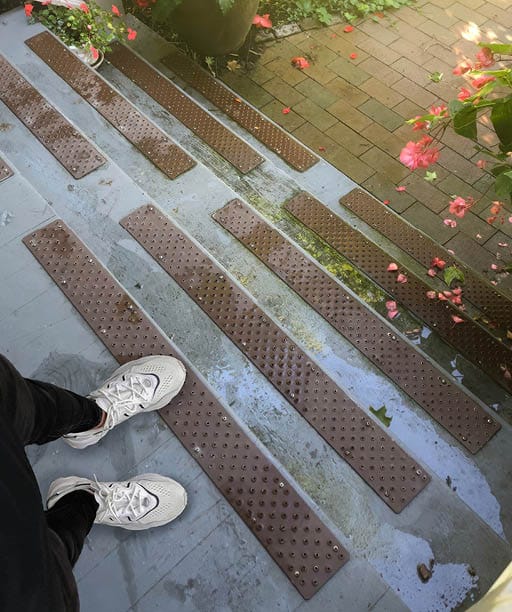
Where temporary solutions are sensitive to installation windows or surface contamination, HandiTreads can be fastened in a wide range of conditions and used immediately. The raised button surface helps to shed water and provide purchase through light snow, supporting year-round traction. Snow removal with a plastic-bladed snow shovel or broom is compatible with these treads.
While upfront costs are higher ($15–$40 per step is a common range), life-cycle costs are definitely lower. A tread that serves 20+ years can undercut the repeated material and labor costs of tape or mats. For example, a 10-step run might cost ~$150–$400 upfront for permanent treads, compared with ~$800–$2,000 over 20 years for recurring temporary replacements (estimates vary with product, labor, traffic, and climate).
Aluminum treads are widely used in demanding settings, and are commonly specified to help meet workplace slip-resistance expectations (including OSHA/ADA-related considerations when properly installed as part of a compliant system). Their low-profile geometry helps avoid trip edges while delivering high traction consistency.
Installation is straightforward: position and fasten with screws (wood) or appropriate anchors (concrete). This typically takes a few minutes per tread. Maintenance usually amounts to occasional debris removal — no curing, re-coating, or routine replacement cycles.
Beyond economics, a permanent lifetime-warranty-backed installation reduces the chance of maintenance-related safety gaps. For households with older adults, high-traffic stairs, or climates with frequent precipitation, that consistency can be a decisive factor.
| Factor | Rubber Matts | Grit Tape | Permanent Aluminum Treads |
|---|---|---|---|
| Durability | ~1–4 years; UV and weather aging | ~6–18 months outdoors; adhesive fatigue | Often 20+ years; no adhesive layer |
| Weather Performance | Can be slick in ice/snow; moisture trapped below | Adhesive sensitive to moisture/temps; snow covers grit | Raised texture helps maintain traction in varied conditions |
| Maintenence | High: cleaning, monitoring, replacement | High: frequent inspection and replacement | Low: occasional cleaning only |
| Safety Reliability | Variable; condition-dependent | Variable; wear-out creates gaps | Consistent; minimal performance drift |
| Installation | Simple; may shift/adhesive issues | Easy; requires specific install conditions | One-time mechanical fastening |
| 20-Year Total Cost | ~$40–$150/step (replacements) | ~$80–$200/step (replacements) | ~$15–$40/step (one-time) |
| Professional Use | Less common | Less common for exterior durability | Common in commercial/industrial settings |
For long-term outdoor performance across seasons, permanent aluminum non-slip treads generally provide the most consistent traction with the least maintenance compared with short-term alternatives.
Rubber mats can add traction, but winter can reduce their effectiveness. Freezing conditions and snow cover may make rubber surfaces slick unless mats are frequently cleaned and monitored.
Outdoor grit tape for stairs commonly needs replacement in the 6–18 month range, depending on traffic, climate, and installation quality.
In many cases, yes. Over 8–10 years, one-time anti-slip stair tread installations often cost less than repeated tape or mat replacements, while offering steadier traction.
All three categories can be DIY projects. Tapes and mats are fastest to apply; aluminum treads require basic tools for fastening but typically need no curing time.
Prevention depends on consistent traction. Solutions that maintain performance year-round with minimal degradation — often permanent aluminum treads — tend to reduce risk over time.
They benefit from regular cleaning and inspection. Replacing mats before they degrade helps maintain safety.
Performance drift between installations. As tapes/mats wear, there can be periods where traction is reduced before replacement occurs.
Many facilities favor permanent stair treads because they reduce maintenance cycles and help sustain slip-resistance over time.
Yes. Workplace and accessibility rules expect consistent slip-resistance. Properly installed permanent stair treads are commonly used as part of meeting those expectations.
This analysis has considered three approaches to improving outdoor stair safety. Rubber mats and grit tape can quickly improve traction and are helpful in targeted, short-term, or low-traffic scenarios. Their trade-offs are durability and maintenance — both require ongoing monitoring and periodic replacement to avoid safety gaps.
Permanent aluminum treads offer a different profile: higher upfront cost but low maintenance, all-weather consistency, and multi-year service life. For many homeowners and businesses prioritizing dependable, long-term protection, that combination delivers strong value — financially and from a safety perspective.
Ultimately, the best non-slip stair option is the one that fits your environment, usage, and maintenance expectations — while keeping people safe every time they take a step.